by Stephen Smith
Associate Professor, God’s Bible School & College
What we believe about Jesus Christ is one of the most important things about us. Recently I was with my family at a restaurant and saw two friendly, well-dressed young men. I recognized them as representatives of either the Mormons (with over 17 million members worldwide) or the Jehovah Witnesses (with over 8 million members). These groups share a common characteristic with Islam, which has over 2 billion adherents and is the fastest-growing major religion. All these false religions deny that Jesus Christ is fully God and fully man. Perhaps most shockingly, in a 2022 poll of over 3,000 adults in the United States (www.thestateoftheology.com), 55% of them either strongly or somewhat agreed with this statement: “Jesus is the first and greatest being created by God.” In the same poll, 53% of the respondents either strongly or somewhat agreed that “Jesus was a great teacher, but he was not God.”
This widespread doctrinal error actually goes all the way back to the first century, when John asserted that the person who denies that Jesus is the Christ is a liar (1 John 2:22) and that every spirit who refuses to confess that Jesus Christ has come in the flesh is not of God, but is the spirit of the antichrist (1 John 4:3). John realized that unless Jesus was fully God and fully man, He could not be our advocate with the Father, who provides the atoning sacrifice that is sufficient to deal with the sins of the whole world (1 John 2:1–2).
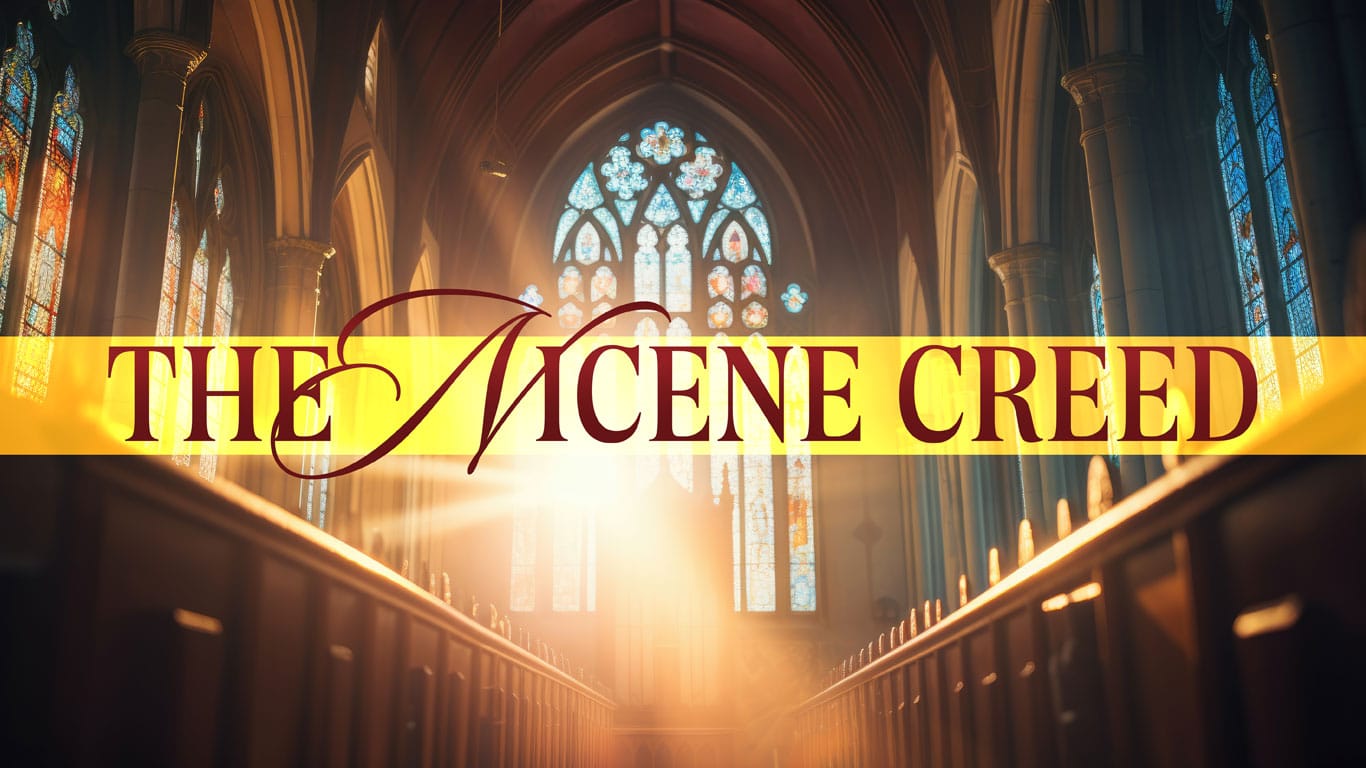
Less than 250 years after John wrote, the heresy that he warned of was continuing to trouble the church. A young man named Arius in Alexandria, Egypt began teaching that there was a time when the Son did not exist, and that Jesus is a created being not fully divine in the same way that the Father is. This created such a rift in the church that Emperor Constantine gathered a large group of church leaders to Nicaea (in modern-day Turkey). They met in the summer of 325 AD for a historic council, and in 2025 we are celebrating the 1700th anniversary of that meeting. The Creed of Nicaea that they produced unequivocally condemned the heresies of Arius, and in 381 AD another council at Constantinople further refined that confession into the Nicene Creed that we confess today.
Despite the widespread heresies still around us, the Nicene Creed provides a guide as we continue walking in the truth to which John said the Holy Spirit bears witness (1 John 5:6). In 2 Peter 1:21, the apostle tells us that the Scripture came about as “holy men of God spoke as they were moved by the Holy Spirit.” The Creed functions as a summary of that biblical witness, a shorthand way of expressing the faith that has been handed down from the apostles. Whatever subjective experiences God’s people encounter, the objective Word of God is a bulwark that protects the church from error. We can be grateful for the pastors that gathered at Nicaea 1700 years ago who passed down to us a confession of the biblical truths about who God is that provide a foundation for our faith.